A row of drips directly beneath a support wire is a different problem from beads hanging across the whole roof. Before blaming the film, follow the water: where does it first collect, and where does it leave the cover?
Anti-condensation film helps moisture spread and drain. The roof can still be wet while that surface is working. The useful clues are the shape of the water, the location of the drips and whether the pattern has changed since installation.
At Greenhouse Plastic, standard IRAC is the only film we currently stock with anti-condensation. Its AC treatment wears off over time, so the plastic may remain intact after its ability to spread and drain condensation has declined.
EVO AC, also called Lifetime AC, is available by special order. When assessing a dripping problem, check which film you purchased and follow the instructions for that specific grade.
Follow the water to the first interruption
On an effective anti-drip surface, condensation spreads into a thin water layer. If it runs along the roof and then drops from a wire, the interruption deserves attention. If it forms separate beads over a broad area, check the film's active surface and identity.
| The pattern | The next check |
|---|---|
| Drips follow a wire or rope | Look for contact interrupting the water's route down the cover. |
| Water collects in a low pocket | Have the installer check both support and tension at that location. |
| Beads cover much of a new sheet | Check the grade, active side and any activation requirements. |
| A previously draining surface starts beading | Identify its anti-drip system and inspect for surface changes or damage. |
Inspect while the dripping is happening. A dry roof in the afternoon can hide the route. If water enters only during rain, also check for a puncture or opening; a leak needs a different fix.
A water pocket does not tell you to pull the cover tighter. Insufficient support can also create a sag. Have the cause checked before adjusting tension, and keep structural wires and ropes in place. At the roof edge, check whether the draining water is being collected or falling back into the growing area.
A new cover: orientation, activation and surface damage
Use the identification on the roll and the instructions for that grade to establish which surface faces the crop. Shine or appearance is not a reliable substitute. If the marking is unclear, send us a photograph before deciding to refit the cover.
Some anti-condensation films need time and suitable humidity to develop their full anti-drip effect. Follow the instructions supplied with your film, or contact Greenhouse Plastic for guidance on activation and installation.
Avoid scraping the active surface against the structure or support wires. A scratch can affect condensation behavior without making a hole. Photograph any strips or patches where beading differs from the surrounding sheet. An activation period does not rule out incorrect orientation, surface damage or a blocked drainage route.
An older cover: identify the anti-drip system
With conventional anti-drip film, additives migrate to the surface and gradually become depleted. The plastic can remain intact after its anti-drip effect has declined. The duration depends on the formulation and growing conditions; the age of the cover alone does not establish whether its treatment has worn out.
EVO AC uses a non-migratory surface system. That distinction matters when comparing a new drip problem with the film's age. A general lifespan estimate for conventional additives should not be used as the expiry date for EVO AC, or for every product described as anti-condensation film.
Classic AD and EVO AC
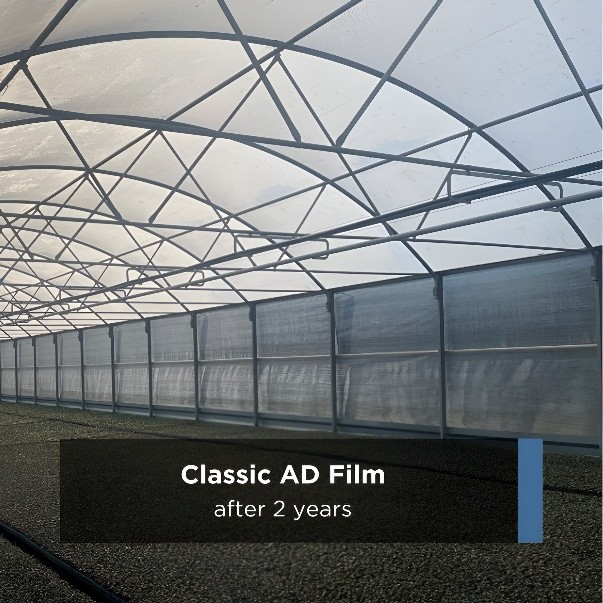
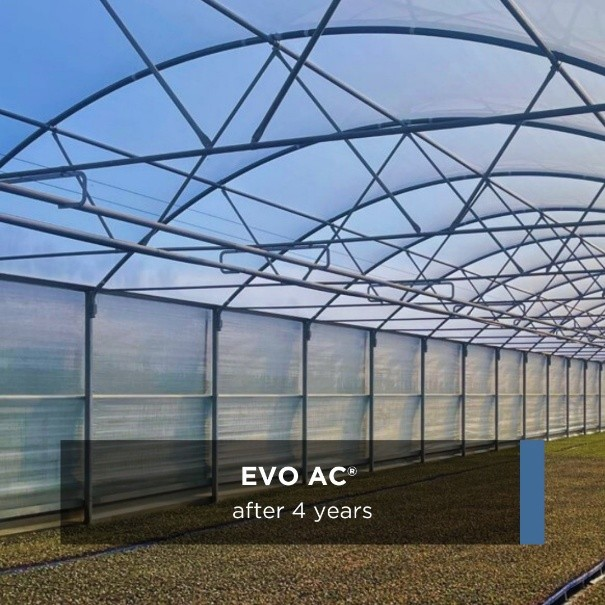
Classic AD film after 2 years; EVO AC after 4 years.
Keep the roll label and installation date with your photographs. We can use that information to check the applicable product guidance. Our Lifetime AC article explains the technology in more detail.
Mist in the air needs a separate check
Droplets attached to the roof and fog suspended inside the greenhouse are different observations. Anti-drip describes water behavior on the film; anti-mist addresses fog inside the structure. A roof that drains can still be part of a greenhouse with a humidity problem.
Plants, wet growing media and standing water add moisture to the air. As temperatures fall, cold surfaces can reach the dew point. Record temperature and humidity when dripping or mist appears, rather than relying on a reading taken hours later.
Where crop needs allow, time irrigation so wet surfaces can dry before evening and reduce standing water. Air circulation helps reduce temperature differences around the crop. Ventilation removes moisture; heating alone does not remove water vapor. Coordinate the two with the crop and equipment instead of expecting the covering to handle the whole moisture load.
Frequently asked questions
Does anti-condensation film prevent condensation?
No. It helps moisture spread into a thin layer that can drain down the cover instead of collecting as hanging droplets. Moisture can still form on the roof, so a wet surface alone does not mean the AC treatment has failed.
Can the AC effect wear off while the plastic is still intact?
Yes. On standard IRAC, the AC treatment wears off over time while the film may still be physically intact. Treatment life depends on the film and growing conditions. Check the product guidance rather than assuming AC lasts as long as the cover.
Does dripping mean I need to replace the cover?
Not necessarily. First check the drainage route, low pockets and surface condition. For a new cover, also check the active side and activation instructions. Send us the roll label, installation date and photographs of the dripping area so we can help you identify the next step.
Show us where it drips
Send the roll label, installation date and two photos: a close-up of the wet surface and a wider view of that part of the frame. Tell us when it happens and whether it was raining.