Secure the leading edge
Fix the free edge of the film at one end of the greenhouse. Keep the width folded at this stage.
A new greenhouse cover can be damaged while it is being fitted. A sharp frame edge can score the sheet, loose folds can snag during placement, and excess tension can increase the risk of tearing in colder weather.
Inspect the arches, support wires and fastening hardware before bringing the film onto the structure. Metal tubes should be clean and free of rust and sharp edges. Replace rusty support wires, and check that clips are clean and in good condition. The frame should allow the cover to tension evenly.
Pay attention to the path the film will take during placement. Loose wire ends, stones, timber scraps and metal offcuts can damage a sheet as it moves past them. Clear the ground wherever the roll or folded film will be laid out.
A smooth surface can still be unsuitable for direct contact. Avoid PVC pipes, profiles and clips containing plasticizers that can deteriorate the film. Check the compatibility of anything that will remain against the cover.
Keep the film horizontal in its original packaging, in a cool, shaded place out of direct sunlight until installation. Once the wrapping is removed, inspect the roll, particularly both ends. If you find visible transport damage, photograph it and contact us before fitting the cover.
Keep the roll label and an 8 × 8 inch sample carrying the manufacturer's identification, as recommended in the installation guide. Plan for the sample without cutting into the area needed to cover the structure.
Choose a calm day with mild temperatures. The recommended ambient range is 50–72°F (10–22°C). Conditions during fitting affect tension, so check the forecast before opening a large sheet. Arrange the people and handling equipment needed for your structure and roll size in advance.
Films with an anti-condensation surface have a designated side that faces the ground. Confirm the orientation from the roll markings and the instructions for the film you ordered before it is fastened. If the markings are unclear, send us a photograph of the label and printed identification.
For EVO AC® film, avoid scratching the active surface on the arches or the ground. Surface damage can affect its condensation-management function even without a visible hole.
A wide sheet can be folded into a narrow strip and wound onto a roll. Unrolling releases its length; unfolding opens its width.
You can place the film from the roof or from prepared ground, depending on your structure and handling setup. Use access and handling equipment appropriate to your site.
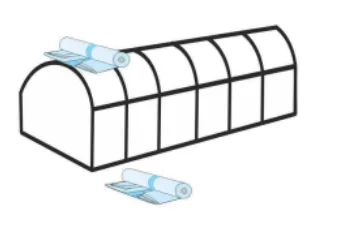
Fix the free edge of the film at one end of the greenhouse. Keep the width folded at this stage.
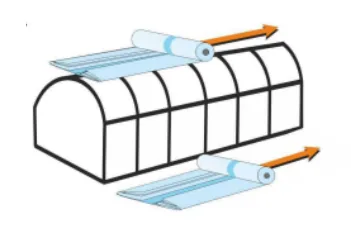
Advance the roll toward the far end, releasing the full length as you go. Keep the folds together until the entire length is laid out.
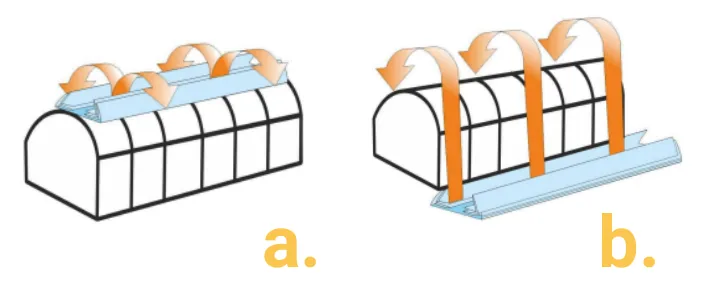
Once the length is in place, unfold the sheet across the greenhouse and secure it using the structure's fastening system. The diagram shows unfolding from the roof (a) or bringing the opened cover over from ground level (b).
The cover needs enough tension to stay stable in wind. Loose film flaps against the frame, and repeated movement weakens it. Pulling excessively can reduce the film's ability to stretch and increase the risk of tearing when it contracts in colder weather.
Follow the fastening arrangement for your structure and check that tension is distributed evenly. Where ropes or belts hold the film, inspect them regularly and adjust them when needed.
For an inflated double cover, uniform, constant air pressure between the layers maintains tension. Check the inflation system as part of fitting the cover, using its specified settings. Use outside air for inflation to avoid drawing crop-treatment chemicals between the films.
Frame contact points need protection from heat as well as abrasion. The installation guide calls for white, opaque, water-soluble acrylic paint on the film surface at metal contact areas immediately after cladding. This reflects sunlight and limits overheating at those points. Oil-based paint must not be used.
Protective tape developed for this purpose can also provide protection. Use a product intended for greenhouse-film contact areas, and follow the guidance for your film and structure. This protection needs to be maintained throughout the cover's life; it is separate from tape used to repair a tear.
The installation guide treats contact-point protection as a condition of the film lifetime warranty, with an exception for double-inflated structures where the treatment is not possible. Check the warranty terms for your specific film.
Check for punctures, tears and areas that rub against the structure. Repair holes promptly with adhesive tape made for greenhouse film. Avoid PVC tape. Address the sharp edge or contact point that caused the damage so it does not cut through the repair.
Recheck tension between seasons and after strong winds. Water collecting in pockets is a sign of inadequate tension or insufficient frame support. Inspect the affected area to establish which is causing the sag before making adjustments.
Cleaners, disinfectants and whitewash-removal products can harm the cover, and chemical deposits at frame contact points can accelerate deterioration. Check chemical compatibility before using products on or near the covering.
Send us the roll label and a photo of the marking, frame contact point or damaged area you want us to check.
Contact Greenhouse PlasticThe complete guide covers film placement, use and maintenance.