Is IRAC Greenhouse Plastic Worth the Cost? Heating Savings, Payback, and When It Makes Sense
March 26, 2026
Quick Decision Guide: Is IRAC worth it for you?
What IRAC film actually does (in plain English)
At night, greenhouses lose heat as infrared (radiant) energy. Standard clear film lets more of that infrared energy escape. IRAC films are engineered to reduce that radiant heat loss, helping your structure hold onto warmth longer after sunset.
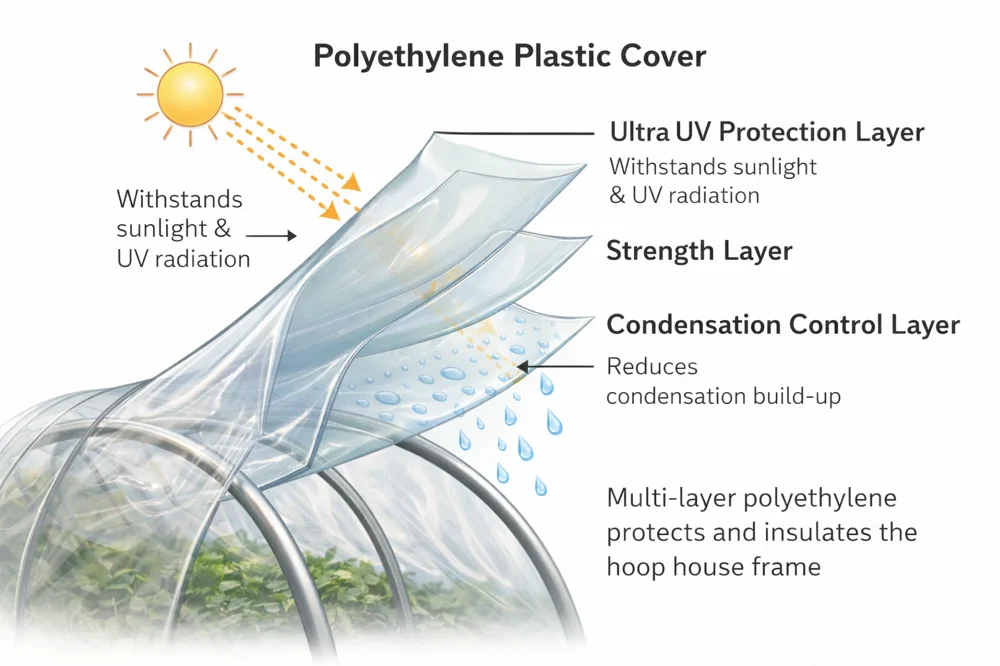
Many IRAC films also include additives aimed at reducing condensation drip, but the exact behavior depends on the specific film formulation. The important point: IRAC is not "magic insulation." It's a film property that can improve nighttime heat retention, especially when you're already heating or when night heat loss is your main pain point.
When IRAC is worth the cost (and when it isn't)
Installation quality and climate often matter as much as film specs for real-world performance and lifespan.
IRAC tends to be worth it when the value of temperature stability exceeds the premium you pay for the film. That value can show up as lower fuel use, fewer cold-stress events, and more consistent growth in shoulder seasons.
If you never heat (or only cover for short windows), the economics usually shift: the premium has fewer "heated nights" to pay itself back, so the decision becomes more about crop protection, light, and durability than energy savings.
What you're paying for
Think of the premium as paying for better nighttime performance. In practice, the biggest differentiators are:
Radiant heat retention (reducing infrared heat loss at night).
Potential condensation-management behavior (varies by film).
Often stronger performance in cold-night, shoulder-season use cases.
How much can IRAC reduce heating cost? A simple example
Conceptual view: IRAC film helps reduce radiant heat loss at night compared to standard clear film (actual savings depend on structure and climate).
Example (simple, conservative framing):
Suppose you run nighttime heat during shoulder season and spend about $2,000 per season on fuel for one house.
If IRAC reduces effective nighttime heat loss enough to lower that fuel spend by roughly 5–12% (range varies widely by structure, sealing, wind, thermostat strategy, and climate), that's about $100–$240 saved per season.
One-line payback: If the IRAC premium for that house is around $250–$500, simple payback is roughly 1–5 seasons (often faster in colder climates, slower in mild climates).
Shop IRAC film for cold nights
IRAC greenhouse plastic is designed to reduce nighttime heat loss in cold climates while still letting in strong daylight. If you're weighing thermal performance vs. max light, compare IRAC to our clear film.
Condensation isn't just cosmetic—drip on plants increases disease pressure and can turn "good" heating into "wasted" heating if humidity swings are large. If drip is a recurring issue, film selection matters, but so do airflow and circulation.
Treat IRAC (and any anti-drip claim) as part of a system: venting, fans, and consistent temperature management still do heavy lifting.
IRAC + double layer inflated systems
A double-layer inflated setup adds an insulating air layer—often one of the biggest steps you can take to reduce heat loss. Many cold-climate growers combine double poly with IRAC for stronger winter performance: the air gap reduces conductive/convective losses while IRAC targets radiant losses.
Installation and longevity: what changes the outcome
Even the best film underperforms with flapping, rubbing, or uneven tension. Longevity and performance improve when you:
Maintain uniform tension (reduce flapping in wind).
Eliminate abrasion points at ribs/edges (smooth contact surfaces).
Avoid chemical exposure that can accelerate degradation (follow your heater/chemical guidance).
Inspect annually and address small wear points before they propagate.
IRAC greenhouse film designed to hold heat on cold nights
Buying for multiple houses or a large roll? Ask about volume pricing and commercial sizes: Contact us
FAQs
Is IRAC greenhouse plastic always worth the extra cost?
No. It's most often worth it when you heat at night or when crop sensitivity makes temperature stability valuable. In mild climates with little heating, standard clear film is often the better value.
Will IRAC replace the need for a double-layer inflated system?
No. Double poly adds an insulating air layer and is usually a bigger lever. IRAC can complement double poly by reducing radiant heat loss.
Does IRAC reduce condensation drip?
Many IRAC films also target condensation behavior, but results depend on the specific film and your airflow management. Venting and circulation still matter.
Is thickness (6 mil vs 8 mil) more important than IRAC?
Thickness affects durability and tear resistance. IRAC targets nighttime radiant heat loss. In cold-night use, IRAC can matter more for heating cost than thickness alone.