6 mil vs 8 mil Greenhouse Plastic: Differences, Lifespan, and When to Choose Each

March 18, 2026

Quick decision tree: 6 mil or 8 mil?

If you're deciding between 6 mil and 8 mil greenhouse film, you're really choosing a durability margin. The thicker film doesn't magically make the greenhouse warmer or brighter—but it can make the cover survive wind, handling, and rubbing points that would shorten the life of thinner film.

  1. Is your site windy (regular gusts, open fields, ridge lines) or do you expect the film to rub on contact points?
    • Yes → start with 8 mil
    • No → go to #2
  2. Are you covering a larger structure (bigger span, more surface area) or keeping film up for long seasons?
    • Yes → 8 mil (better tear margin)
    • No → go to #3
  3. Do you want the best value for typical hoop houses and moderate climates?
    • Yes → 6 mil (common baseline)
    • If you're unsure → 8 mil is the safer durability pick

What actually changes when you go from 6 mil to 8 mil

6 mil (0.006")

Thickness:
Baseline thickness for many hoop houses
  • Tear resistance: Good
  • Handling: Easier to pull tight
  • Best for: Most climates / smaller tunnels
  • Trade-off: Shorter lifespan in high winds

8 mil (0.008")

Thickness:
8 mil film is ~1.3× thicker than 6 mil
  • Tear resistance: Higher
  • Handling: Stiffer; needs more hands
  • Best for: Windy sites / long seasons
  • Trade-off: Higher cost + heavier install
At a glance: 6 mil vs 8 mil—what changes (strength/handling) and what stays similar (light for clear film).

8 mil is about 33% thicker than 6 mil, which translates to higher tear resistance and a film that is less likely to "zip" once a small nick starts.

The trade-off is handling: thicker film is stiffer, heavier, and usually easier to install with an extra set of hands—especially on larger structures.
Expected lifespan: 6 mil vs 8 mil

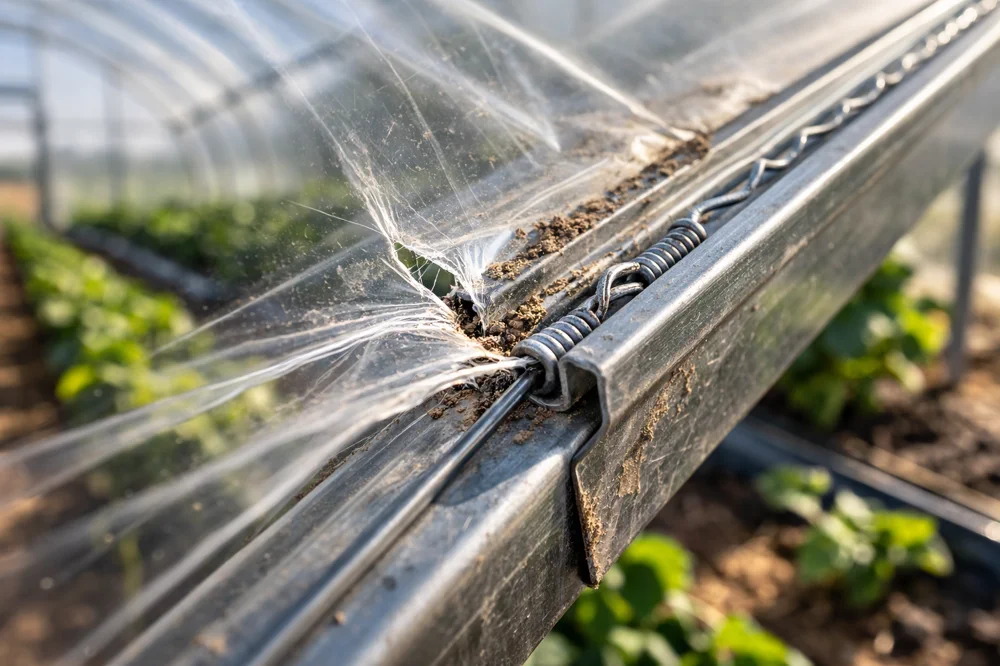
Close-up of greenhouse film secured in a lock channel with wiggle wire, showing a high-stress edge where tearing can start
High-stress edges (lock channel + wiggle wire) are where film abrasion and small nicks often turn into tears—proper tension and protection at contact points helps.

Lifespan is driven by stress more than thickness: UV exposure, wind flapping, and abrasion at contact points. In calm sites, 6 mil can be a great value. In windy or high-handling environments, 8 mil often lasts longer simply because it survives the "bad days."

If your greenhouse is in an open field, on a ridge, or you've torn film in past seasons, stepping up to 8 mil is usually cheaper than replacing film early.

Need help choosing 6 mil vs 8 mil for your greenhouse?

If you tell us your greenhouse size, wind exposure, and season length, we'll recommend the best thickness (and the right width) for your setup.

  • Fast sizing + thickness recommendation
  • Commercial orders welcome
  • Cut-to-length options available

Handling and installation differences

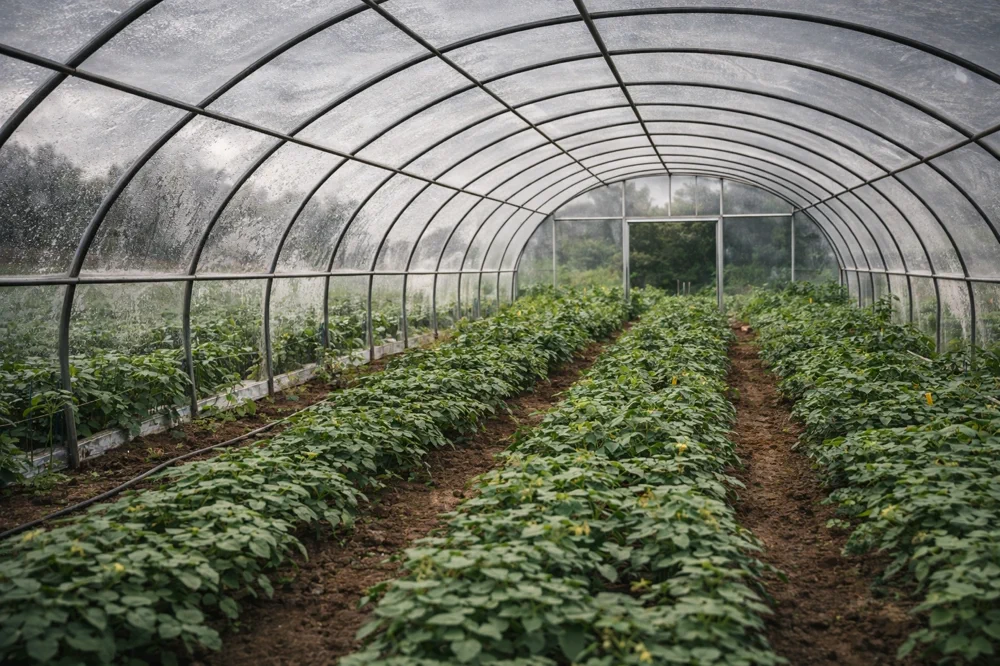
Close-up of greenhouse plastic stretched tight over hoops showing tension and clarity.
Proper tension and clean fastening reduce flapping—one of the biggest drivers of film wear.

Most installation problems happen at the edges and contact points: loose film flaps, rubs, and eventually tears. Whichever thickness you choose, prioritize tension and clean fastening.

6 mil is more forgiving to pull tight; 8 mil is stiffer and may need more hands to avoid wrinkles. If you're covering a bigger span, that stiffness can actually help the film stay stable once it's properly tensioned.

Cost and value: when 8 mil pays for itself

Choose 8 mil when a premature replacement would be painful: commercial labor, large houses, windy sites, or long seasons. Choose 6 mil when you want the best cost-per-season in typical conditions.

Pro tip: if you're already investing in an inflated double layer system, you may still choose 6 mil per layer depending on your wind exposure—because the air layer does most of the insulation work.

Comparison table: 6 mil vs 8 mil greenhouse plastic

How 6 mil and 8 mil film compare in real use
Factor 6 mil 8 mil
Tear margin Good baseline Higher; more forgiving in wind and handling
Handling More flexible; easier to pull tight Stiffer; usually needs more hands on install
Best for Most hoop houses and typical climates Windy sites, long seasons, or commercial handling
Value Lowest cost per season in mild/moderate conditions Often pays off when replacement risk is high

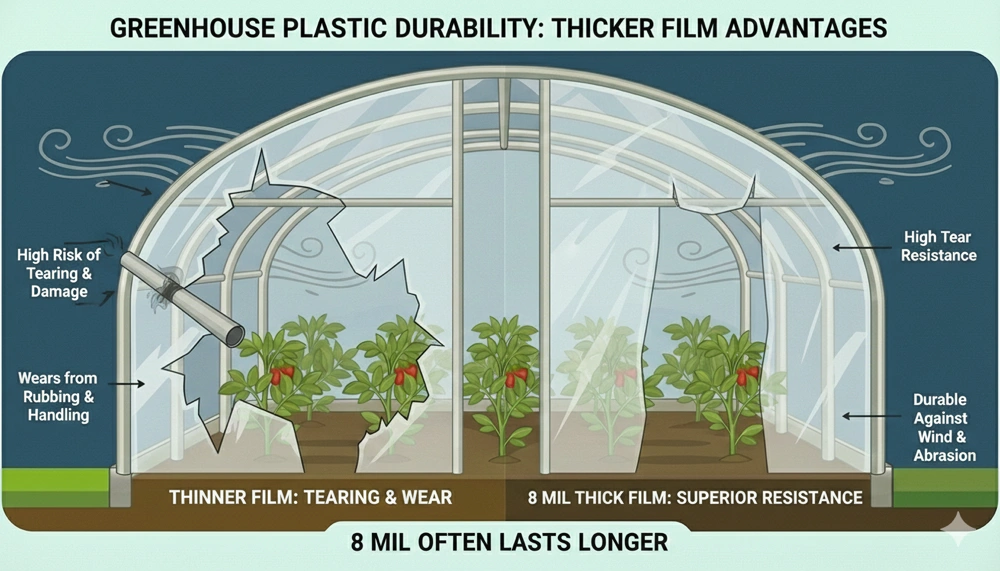
Visual: why 8 mil tends to survive longer in wind and handling

Diagram comparing how thicker film resists tearing and lasts longer in wind and handling.
Why 8 mil often lasts longer: higher tear resistance and better survival in wind, rubbing, and repeated handling.

Ready to order film?

Choose clear or diffused film by width and thickness—or request a quote if you want us to validate your measurements first.

FAQs

Is 6 mil greenhouse plastic strong enough?

For many hoop houses, yes—especially in sheltered sites and typical seasons. If you're in a windy location or you regularly get film abrasion at contact points, 8 mil gives a larger tear‑resistance margin.

How long does 6 mil vs 8 mil film last?

Lifespan depends most on UV exposure, wind, and how tight the film stays. As a rule, 8 mil tends to last longer in high‑stress conditions (wind and handling) because it resists tearing and punctures better.

Does thicker film change light transmission?

Thickness alone doesn't automatically change light—additives and film type (clear vs diffused) matter more. If you're comparing clear-to-clear film, the practical differences are usually durability and handling, not plant light.

What matters more than thickness?

Tension and fastening. A tight, well‑secured film that doesn't flap will typically outlast a thicker film that's loose and rubbing on contact points.

Should I choose clear or diffused film?

That's usually a crop/goal decision. Clear maximizes direct light; diffused spreads light more evenly and can reduce harsh shadows. (If you're choosing between those two types, see our clear film and diffused film pages.)