Long summer days can push hoop-house temperatures high enough to scorch sensitive fruit. Suncooler® films are designed to reduce part of the near-infrared radiation associated with heat while preserving the light plants use for photosynthesis.
How Suncooler® cooling films reduce daytime heat
Suncooler® benefits
- Reduces daytime temperatures by up to 12.6°F*
- Improves working conditions
- Provides higher light transmission than competing cooling films
- Reduces water consumption
- Extends the growing season*
- Improves yields by up to 30%*
*Temperature, growing-season and yield results were observed in field trials with specific crops and conditions. Results may vary by location, crop and growing practices.
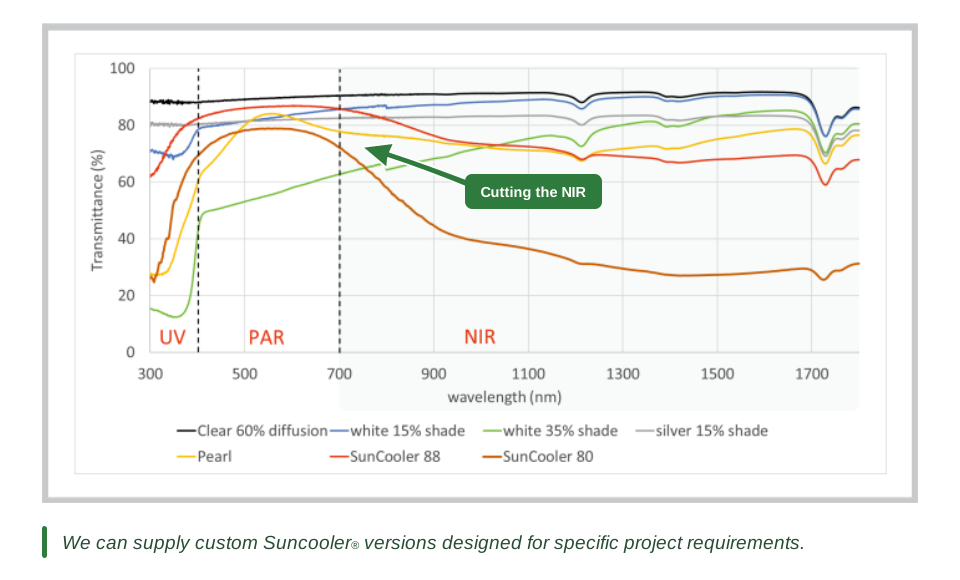
Sunlight contains different bands of radiation, and they do not all affect the crop in the same way. Photosynthetically active radiation, usually shortened to PAR, covers the wavelengths plants use for photosynthesis. Near-infrared radiation, or NIR, lies beyond visible light and contributes heavily to daytime heat accumulation inside a covered structure.
Suncooler® films use NIR additives that absorb part of this heat-producing radiation and dissipate it to the outside environment.
| Measurement | Suncooler® 80 | What it means for the crop |
|---|---|---|
| PAR transmittance | 80% | Maintains a high level of the light plants use for photosynthesis. |
| NIR transmittance | 40% | Limits more of the near-infrared solar load that contributes to daytime heat. |
Unlike a darker shade film, Suncooler® can preserve a high share of PAR while reducing more NIR.
What polydispersive diffusion adds
Suncooler® lowers NIR transmission to reduce daytime heat. Polydispersive diffusion spreads the light passing through the film.
It provides ultra-high diffusion without reducing global light transmission (GLT). By scattering sunlight at high angles, it reduces shadows and concentrated light that can scorch exposed fruit.
Measured results from Suncooler® projects
Yunnan blueberry trial
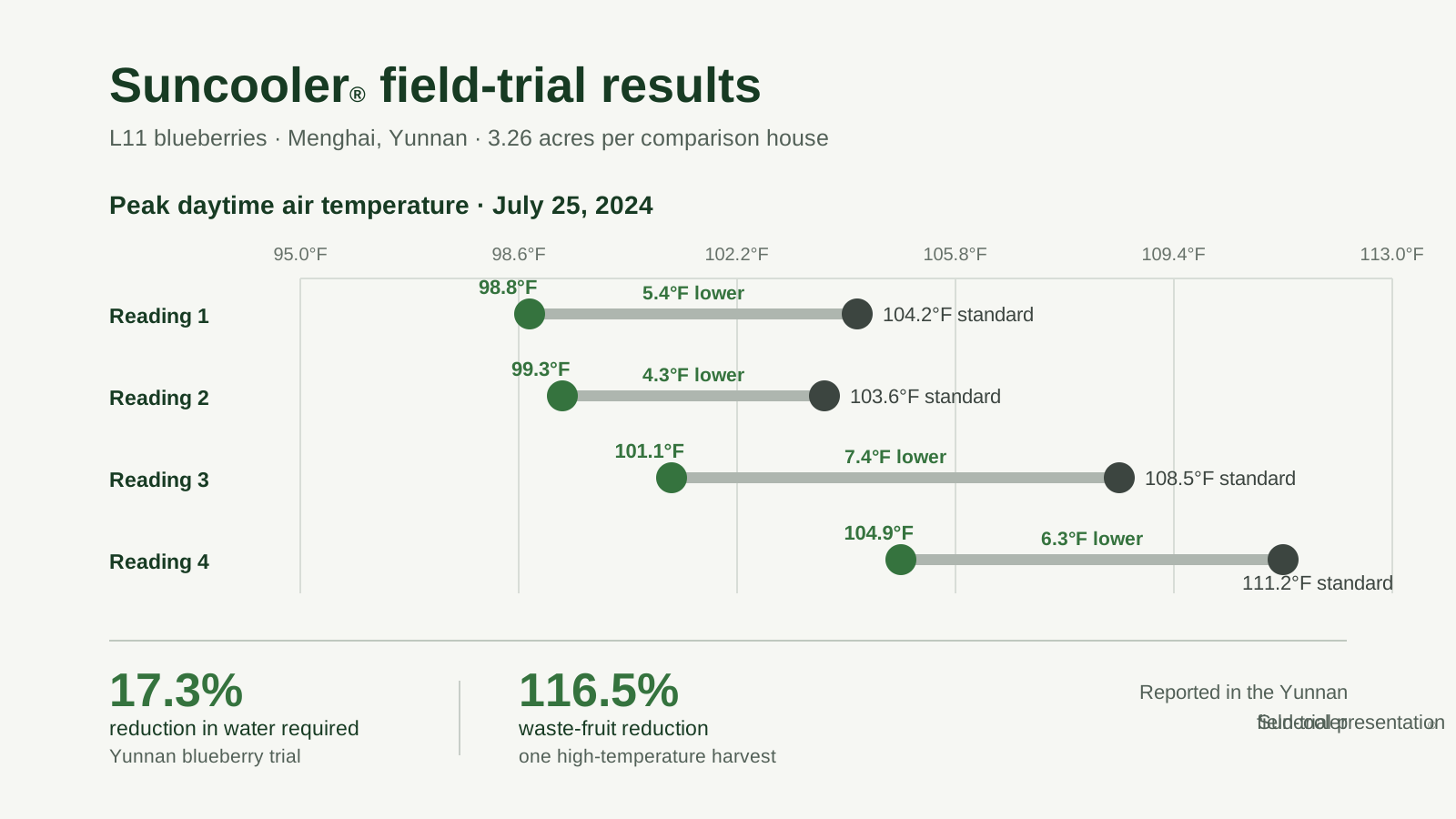
A field trial in Menghai, Yunnan used Suncooler® 85 and standard greenhouse film over L11 blueberries. The experimental and control houses each covered about 3.26 acres.
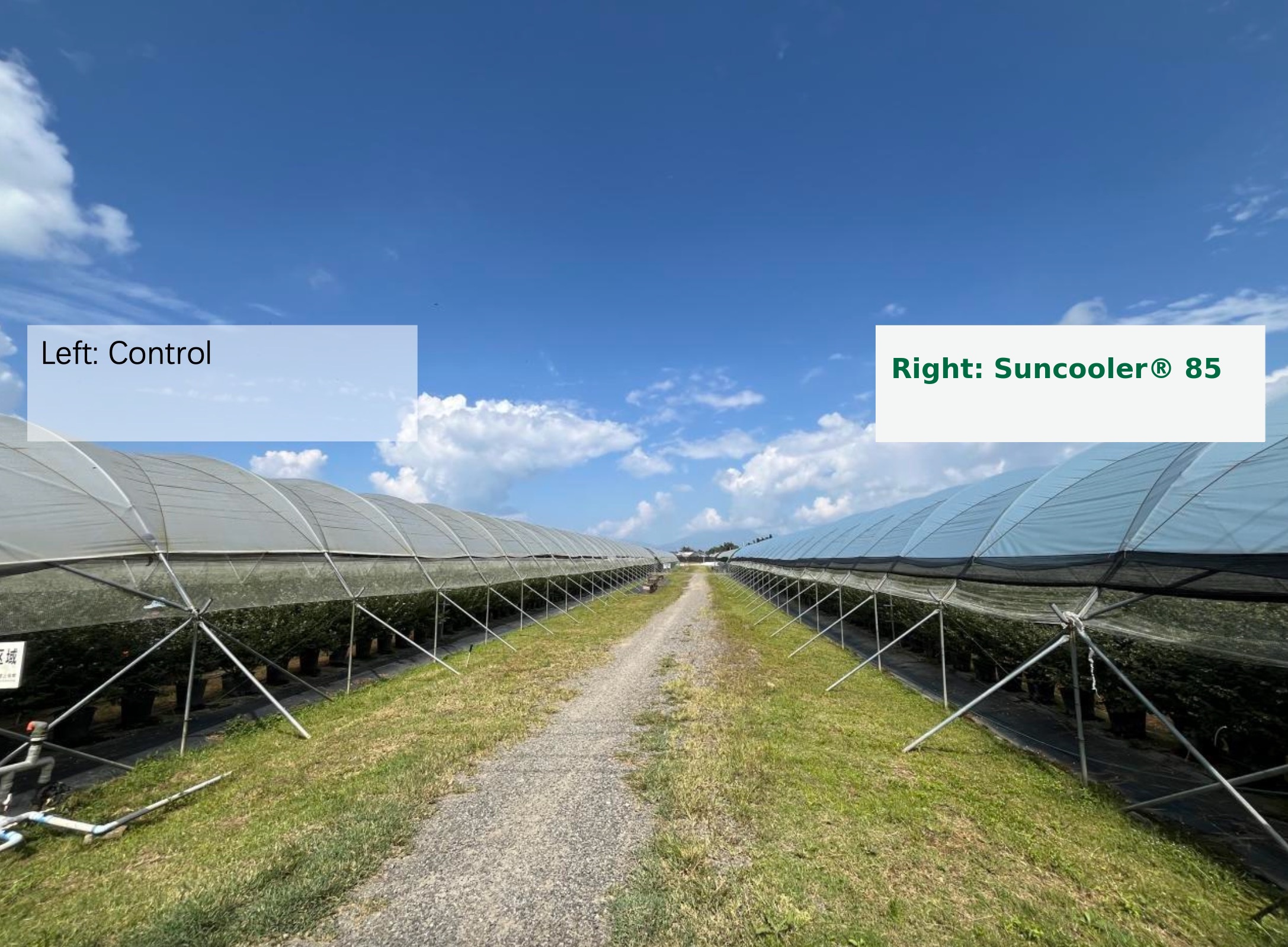
Four comparisons recorded on July 25, 2024 showed peak temperatures under Suncooler® running 4.3 to 7.4°F lower than under standard film.
| Comparison | Standard film | Suncooler® film | Temperature reduction |
|---|---|---|---|
| Reading 1 | 104.2°F | 98.8°F | 5.4°F |
| Reading 2 | 103.6°F | 99.3°F | 4.3°F |
| Reading 3 | 108.5°F | 101.1°F | 7.4°F |
| Reading 4 | 111.2°F | 104.9°F | 6.3°F |
The largest temperature differences appeared during strong-light hours, roughly 9:00 a.m. to 6:00 p.m. A separate comparison on March 7, 2025 recorded 94.8°F under standard film and 90.1°F under Suncooler®, a difference of 4.7°F.
The trial presentation also reports:
- 17.3% reduction in water volume required.
- The trial recorded 5.9% waste fruit under Suncooler® versus 12.7% under standard film. The presentation reports this as a 116.5% reduction.
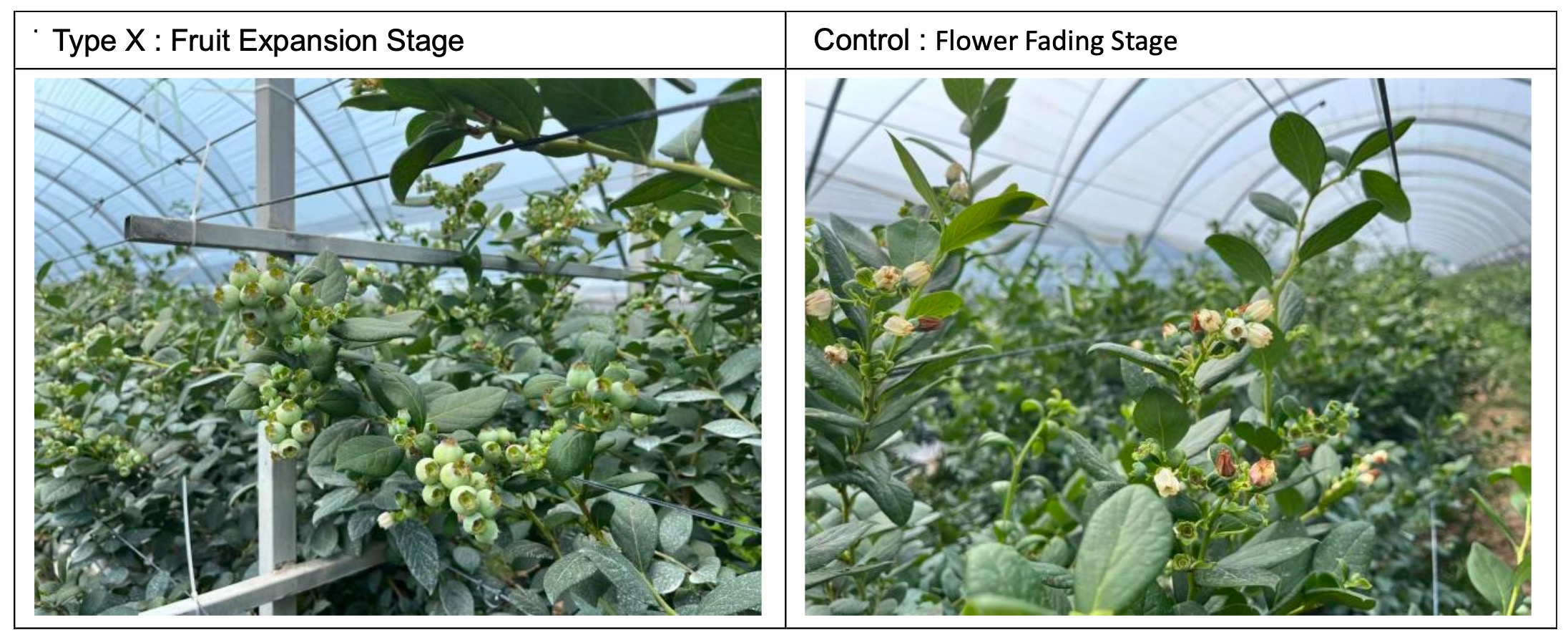
- Flowering 15 days earlier under Suncooler®.
- A 39.9% cumulative yield increase across the first nine pickings.
- Peak production 45 days earlier than the standard-film house.
Agadir raspberry project
The Agadir, Morocco project used Suncooler® 88 over raspberries affected by excessive heat, plant stress, low production and high water use.
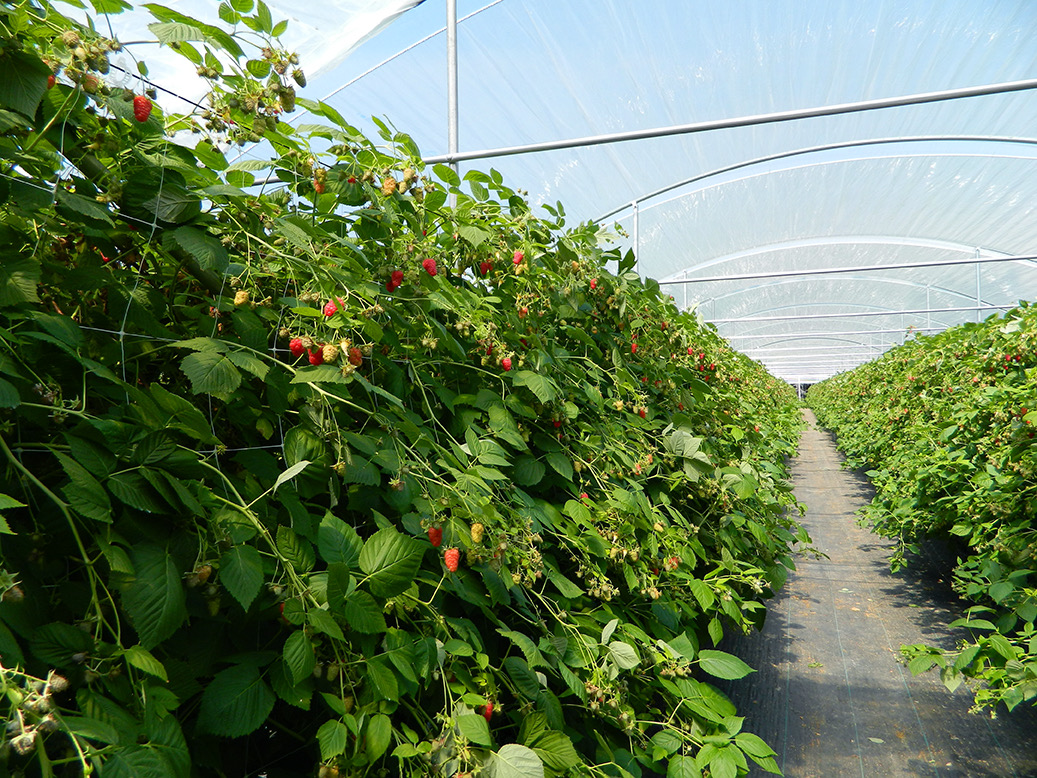
The baseline yield was 25,500 kg per hectare, about 22,751 lb per acre. Suncooler® 88 added 500 kg per hectare, about 446 lb per acre, for an increase of approximately 2%. At the project's crop value of €8 per kilogram (about US$9.34), the additional yield was worth €4,000 per hectare (about US$4,668).
A 15-acre blackberry project in Santa Maria
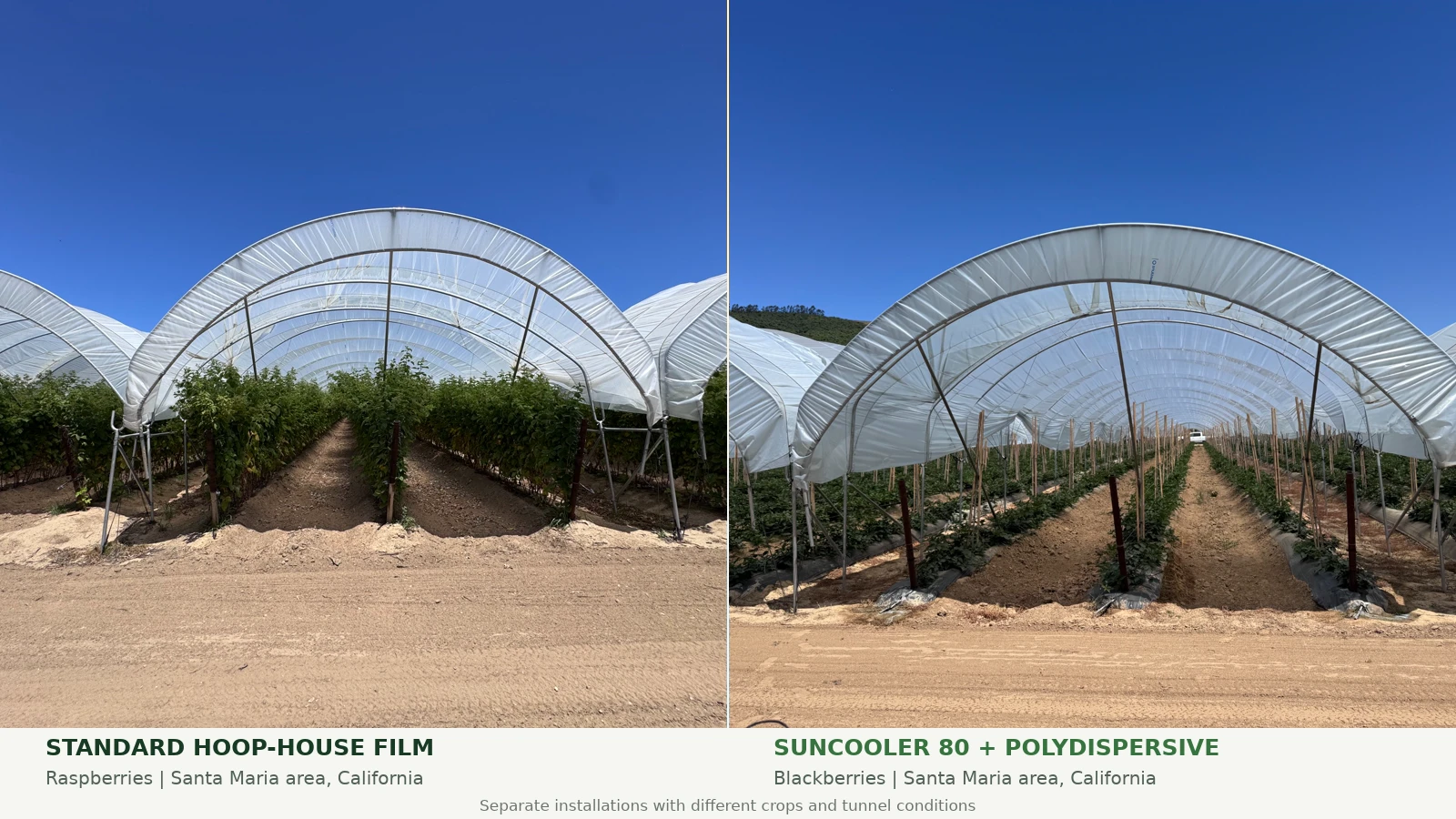
We used Suncooler® 80 with polydispersive diffusion over 15 acres of blackberries in the Santa Maria area. Long summer days on California's Central Coast can scorch exposed fruit, so the project called for more heat control and light diffusion than standard hoop-house film provides.
When we stepped under the film, the temperature difference was noticeable immediately.
When the higher film cost makes sense
We estimate that the Suncooler® 80 with polydispersive configuration used for the Santa Maria project costs approximately 25% more than standard hoop-house film. The premium is easiest to justify for heat-sensitive, high-value crops exposed to long periods of intense sun, especially when growers need to preserve PAR while reducing NIR heat load.
Film is one part of the cooling system. Tunnel design, roll-up sides, ridge or end ventilation, irrigation and daily operating practices still determine how effectively heat leaves the structure. Suncooler® reduces the solar load entering through the cover, which gives the rest of the system less heat to manage.
For a baseline comparison, see our standard hoop-house plastic. You can also review examples of commercial hoop-house projects built for different crops and growing systems.
Request a Suncooler® special order
Send us your crop, location, tunnel dimensions and required film length.
Contact us